
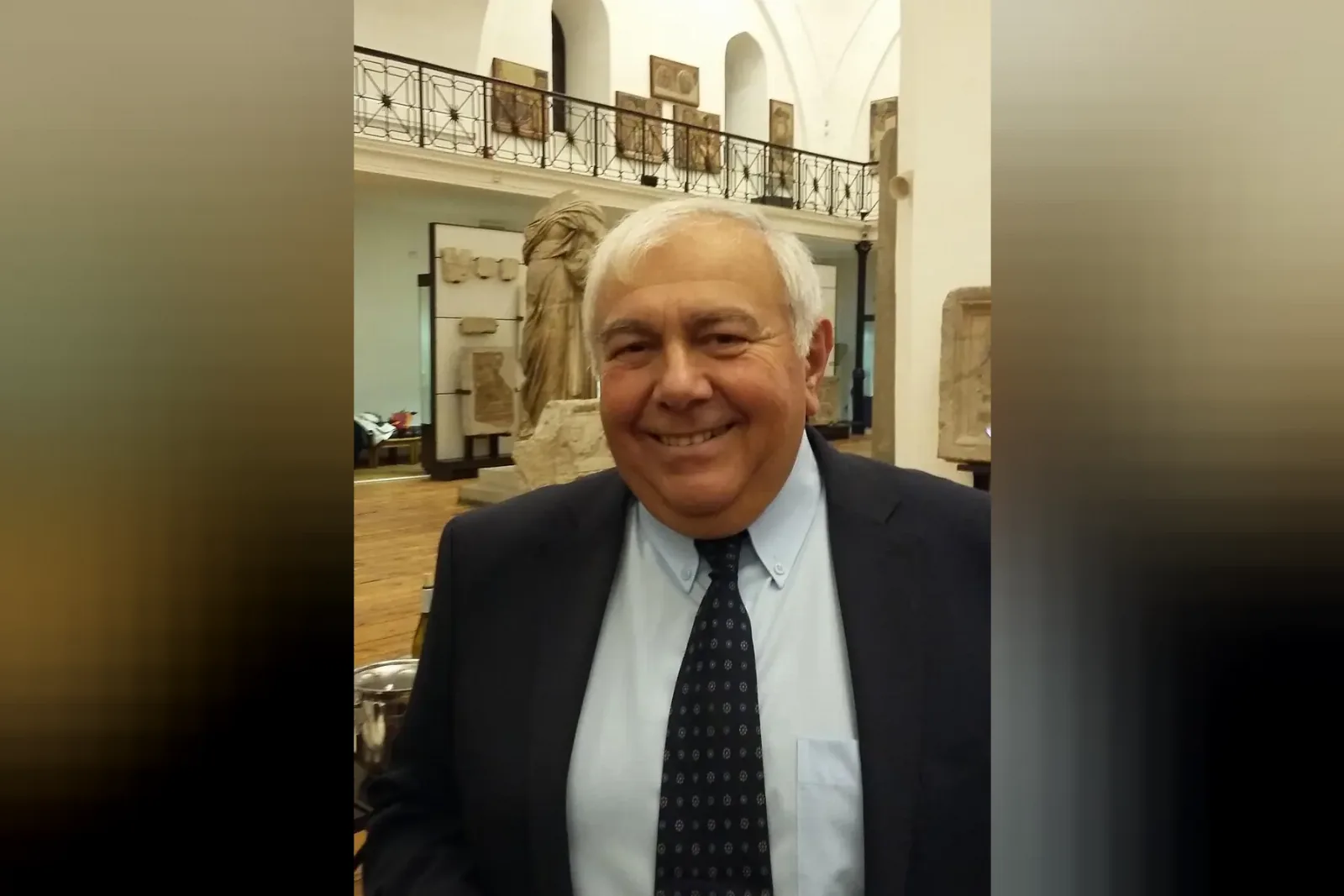
The Bulgarian Academy of Sciences (BAS) marked 157 years since its founding with a ceremony in the Prof. Marin Drinov Hall today. Academician Vasil Nikolov received the academy's 2026 Grand Prize for Science in the social sciences and humanities.
BAS president Evelina Slavcheva, a corresponding member of the academy, presented the award. In her speech she recalled the history of the Bulgarian Literary Society (BLS) and how it became the BAS. Academician Ivan Granitski explained how the winner was chosen.
Granitski said Academician Prof. Dr. Nikolov is an internationally known scientist who studies the late prehistory of the Balkans. His career as a prehistoric archaeologist spans more than four decades. He was director of the National Archaeological Institute with Museum at the BAS and deputy president of the academy.
Nikolov developed a method for studying prehistoric settlements and settlement mounds, drawing on his wide experience in the field. He recognised and studied Neolithic and Chalcolithic sanctuaries, a new type of prehistoric site in the Balkans. With his team, he discovered and studied Provadia-Solnitsata, the earliest prehistoric salt-producing town in Europe, and the earliest stone fortresses on the continent, which were linked to its wealth.
Figures of the Bulgarian Revival founded the BLS in 1869 in Braila. Slavcheva said that at the time science, education and culture were an inseparable part of the Bulgarian people's drive for spiritual and national self-assertion. The society's task was to develop the Bulgarian language, literature, history and science. It was to gather and spread knowledge and lay the intellectual foundations of a future Bulgarian state. Its founders wanted it to become a Bulgarian Academy of Sciences.
After the Liberation, the BLS moved its seat to Sofia. Slavcheva said the society gradually established itself as a national centre of science. In 1911 it was turned into the BAS. She called this a natural continuation: a step from the Revival-era drive for enlightenment and national identity to a modern scientific institution. The academy was to develop and unite scientific knowledge in a free and independent Bulgaria. She described the renaming as a stage in the life of one of the country's oldest institutions.
The first law on the BAS was Decree No. 4 of 27 January 1912, published in the State Gazette, issue 25, on 1 February 1912. Slavcheva said the law set out the academy's status and its relations with the state. It also confirmed the principle that science needs freedom and independence to carry out its public mission. The history of the BAS is tied to the history of Bulgarian science itself, she added.
Academician Georgi Markov gave an academic address titled "The transformation of the Bulgarian Literary Society into the Bulgarian Academy of Sciences in 1911". He said the history of the BAS runs through four eras: the Revival, the Third Bulgarian Kingdom, the People's Republic of Bulgaria and the Republic of Bulgaria. According to Markov, only the history of the Bulgarian Orthodox Church can be compared with it.
BAS deputy president Prof. Emanuel Mutafov hosted the event. Members of parliament, university rectors, scientists, lecturers, former BAS presidents and the chief secretary of the Holy Synod, Bishop Gerasim of Melnik, attended. At the end of the ceremony, students from the National Academy of Music performed a musical greeting.
Mutafov said the BAS leadership had received many messages of congratulation. They came from President Iliana Yotova, National Assembly speaker Mihaela Dotsova and prime minister Rumen Radev. Ministries, universities and other institutions also sent them.






Comments (0)
No comments yet.